
WEEE
Managing End-of-Life When Reuse Is No Longer an Option
When IT equipment reaches the end of its life, not everything is recycled the same way. Some machines can still be reused or partially recovered, while others must be directed to specialised recycling streams.
SERVICE
WEEE Recycling Management by WeeeDoIT
When IT equipment can no longer be reused or refurbished, it doesn’t simply become waste. End-of-life management means disassembling, sorting, and directing each component to the most appropriate stream, based on its material, condition, and recovery potential.
At WeeeDoIT, recycling is never broad or blind: it is targeted, documented, and carried out through specialist partners — to guarantee regulatory compliance, traceability, and controlled environmental impact.
Sorting & Equipment Routing
Each machine is analysed component by component to distinguish what can be reused, recovered, or recycled. Nothing is sent to recycling without technical justification.
Targeted Dismantling
Non-exploitable equipment is dismantled to isolate components and materials. This step avoids unnecessary shredding and maximises material recovery.
Specialised Recycling Streams
Components are directed to approved partners according to their nature: metals, electronic boards, plastics, or composite elements. Each flow follows a dedicated stream.
Traceability & Regulatory Compliance
Every operation is documented: volumes processed, methods used, partners involved. You receive complete traceability compliant with WEEE requirements, ESG reporting, and internal governance needs.
70–80 %
CO₂ reduction compared to non-optimised recycling
24h
to receive our collection offer
+ 95%
material recovery rate
x2 à x3
value recovered vs. direct recycling
WHEN TO RECYCLE?
Adopting the Right Reflexes
Recycling is triggered when reuse or remarketing is no longer relevant. At WeeeDoIT, this decision is made factually, based on clear criteria, and always component by component.
Security & Compliance
When equipment presents a data risk or can no longer be secured.
Critical Non-Repairable Failure
When the repair cost or complexity exceeds the actual value of the component.
No Market Demand
When there is no longer any demand — neither for the machine nor for its components.
End of Technical Cycle
When standards, formats, or use cases make the equipment unusable.
AFTER COLLECTION
Where does IT equipment go to be recycled?
When an IT component or piece of equipment reaches end-of-life, it is never treated as a single block. Each component is separated and directed to a specialised stream based on its nature and what it contains. The objective is simple: send each element to the right operator, capable of processing it correctly.
After processing, materials are reinjected into industrial circuits (smelters, plastics manufacturing, refining), while non-recoverable residues are eliminated according to strictly regulated procedures.
Storage Media
Hard drives, SSDs, magnetic tapes, flash media, memory modules. Recycled by specialist providers in data media destruction and recycling. Data is securely destroyed, then components are dismantled to direct metals and alloys towards the appropriate material streams.
Electronic Boards & Components
Motherboards, storage controllers, network cards, backplanes, RAID cards. Recycled by specialists in electronic board processing. Boards are treated separately to enable recovery of metals embedded in printed circuits (copper, precious metals), via adapted industrial processes.
Electromechanical Components
Power supplies, fans, cooling modules, power boards, internal cabling. Recycled at approved WEEE centres. Components are dismantled and sorted to separate metals, plastics, and electromechanical elements before industrial recycling.
Cables & Connectors
Power cables, network cables, internal harnesses, various connectors. Recycled through specialist copper & plastics streams. Sheaths are separated from the copper core, enabling metal recovery and technical plastics recycling.
Structural & Metal Elements
Server chassis, storage arrays, racks, rails, drawers, sheet metal. Recycled through industrial metal streams. Metals are remelted and reintegrated into industrial circuits for the manufacture of new parts or structures.
Pollutant & Sensitive Components
Batteries (UPS, internal modules), capacitors, boards with chemical components, screens, elements containing hazardous substances. Recycled through specialist depollution and hazardous waste treatment streams. These components are handled by facilities capable of neutralising or extracting pollutant substances (electrolytes, heavy metals, chemical residues). Recoverable materials are isolated; the remainder is eliminated according to regulated procedures.
ITAD
What happens at WeeeDoIT after a collection?
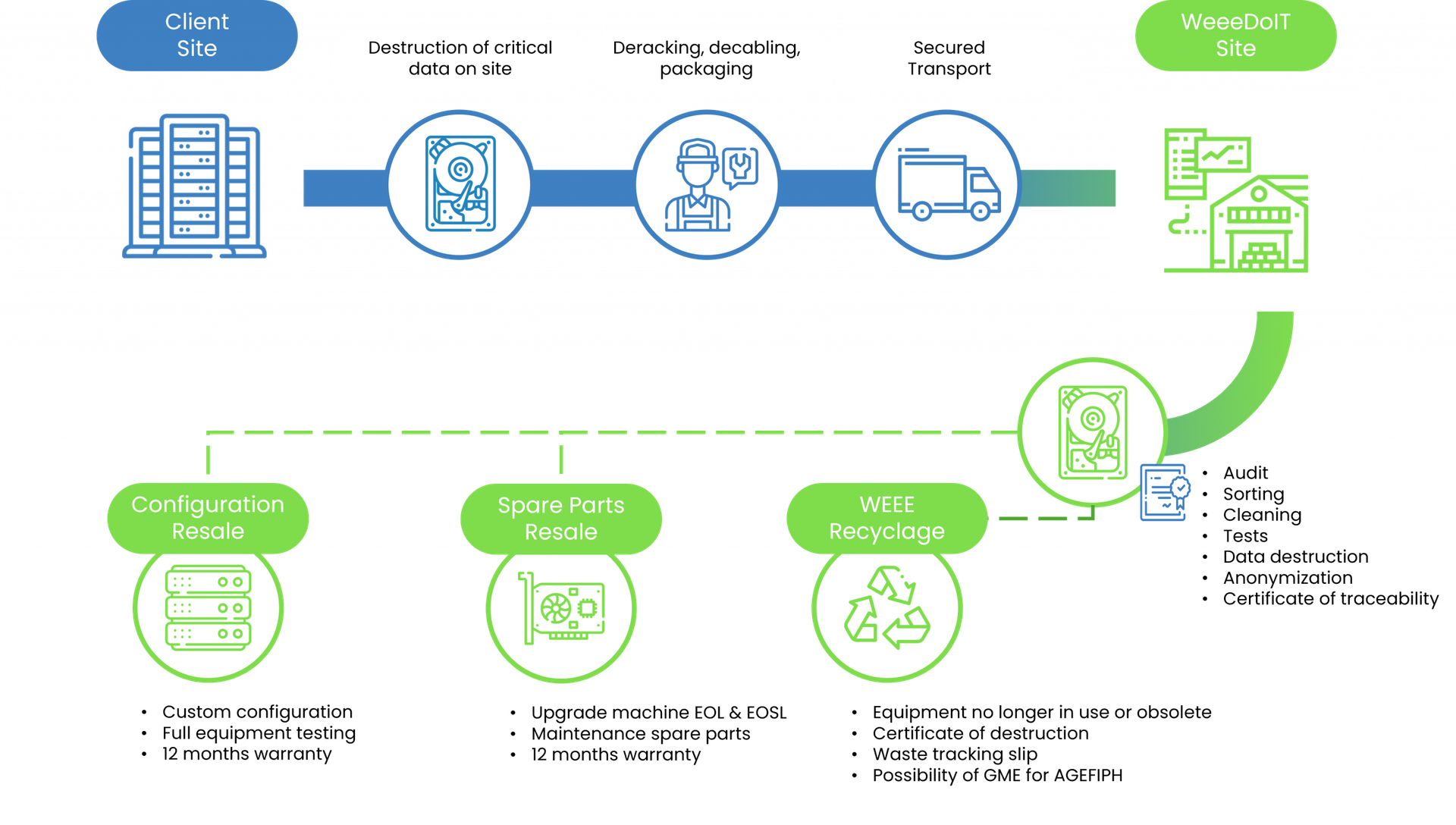
What sets WeeeDoIT apart

Component-by-component vision

Network of specialist partners

Offer based on real value

Traceability and compliance
FAQ
Questions on WEEE Recycling
What types of IT equipment can be recycled?
Recycling applies primarily to components or equipment that can no longer be maintained, reused, or resold for technical, security, or compliance reasons. This includes: incomplete or out-of-service servers, non-functional storage arrays, obsolete or damaged network equipment, faulty components (drives, boards, power supplies, fans), structural elements (chassis, racks, rails), and pollutant or sensitive components (batteries, capacitors). Recycling is always decided after analysis — never automatically.
How do you determine whether equipment should be resold, reused, or recycled?
The decision is based on a technical and economic analysis, carried out component by component. The main criteria are: actual functional condition (tests, diagnostics), compatibility with current standards, existing or absent market demand, security constraints (data, firmware, traceability), and cost of refurbishment vs. potential value. A server may be unsaleable yet still contain high-value components, while another goes directly to material recycling.
Which components are most sought after on the recycling market today?
On the recycling market, value comes not from the whole machine but from what it contains. The most sought-after components are: electronic boards (motherboards, controllers, network cards), enterprise drives and SSDs (even out of service, for their material content), memory modules (DDR4 / DDR5 ECC), power supplies and electromechanical modules, and metals in chassis and boards (copper, alloys, precious metals). Demand is driven by material density, not IT usability.
How does a full collection process work?
A full collection is a structured service, planned with IT teams. It typically includes: scope audit and intervention planning, secure on-site or datacenter collection, component sorting and separation, data erasure or destruction where required, routing to the appropriate streams, and delivery of a compliance report and documentation. The CIO retains clear visibility of the entire flow, from start to finish.
How do you guarantee secure data erasure before recycling?
Every storage medium containing data (hard drives, SSDs, tapes, flash modules) undergoes specific treatment before being directed to any recycling stream. Depending on the case, we apply either certified software erasure compliant with recognised market standards, or physical destruction when software erasure is not technically possible. Every operation is tracked and documented. Recycling only takes place after data neutralisation has been validated, eliminating any residual risk.
How are components containing pollutant or sensitive substances handled?
Pollutant components never follow standard WEEE streams. They are identified, isolated, and entrusted to specialist providers: batteries (UPS, internal modules), capacitors and chemical components, elements presenting an environmental risk. These streams ensure depollution, substance neutralisation, and compliant elimination or recycling. This is a key point of regulatory and ESG compliance.
How is the price of a recycling service calculated?
The cost depends on several technical and operational parameters: the nature of the components to be processed, the presence of data media or pollutant components, logistical constraints (site, volume, access, multi-site), and the level of sorting, dismantling, and reporting required. In some cases, material recovery from certain components can reduce the overall cost — particularly when recycling is combined with reuse or resale operations.
Are operations compliant with WEEE / EU regulations?
Yes. All recycling operations are carried out in strict compliance with WEEE regulations and current European requirements. In practice: components are directed to approved and regulated streams; traceability, flow separation, and waste treatment obligations are met; pollutant or sensitive components follow specific circuits distinct from standard streams; and operations are documented to meet audit, inspection, or reporting requirements. WeeeDoIT acts as orchestrator of the entire chain — we select partners, control flows, and ensure overall compliance, without transferring responsibility to the client.
Where are components physically recycled — France, Europe, or outside the EU?
Components are primarily directed to European streams, selected for their specialisation and regulatory compliance. Depending on the component type, some processing takes place in France, while others are handled at European level when industrial specialisation requires it. WeeeDoIT excludes any uncontrolled or opaque stream. The final destination of components is known, documented, and traceable.
Which approved partners process the components?
WeeeDoIT relies on a network of specialist partners, selected according to strict criteria: regulatory approval, expertise by component type (boards, metals, batteries, storage), and traceability and reporting capability. Each partner operates within a precise scope: approved WEEE centres, electronic board specialists, industrial material streams, and depollution providers for sensitive components.
How do you ensure that the streams used meet environmental standards?
Streams are audited and selected based on their compliance with WEEE and environmental regulations, their current certifications and authorisations, and their ability to provide proof of processing and final destination. WeeeDoIT does not simply subcontract: we manage and control the entire chain, to guarantee responsible, compliant, and verifiable end-of-life management.
Can the overall cost be optimised by combining recycling and reuse?
Yes. Recycling is rarely a standalone action. In many cases, a combined approach allows certain components to be reused or resold, reduces the volume actually sent to recycling, and optimises logistics and processing costs. This arbitrage logic is a core part of the WeeeDoIT approach: recycle only what truly needs to be recycled — and nothing more.