
IT BUYBACK
Resell Your Decommissioned IT Equipment
We buy back your servers, storage arrays, network equipment, laptops, and PCs — whether still functional or end-of-life — to refurbish them or give them a new purpose within a circular economy approach.
SERVICE
IT Buyback & Refurbishment by WeeeDoIT
At WeeeDoIT, we believe that IT equipment can — and should — last far longer than we’re typically led to believe. We practise intelligent remarketing: model-by-model analysis, residual value estimation, technical sorting, refurbishment, and reintegration into the circular economy. This avoids the premature recycling of your servers, storage arrays, workstations, and network equipment — both during and after their manufacturer end-of-support date.
Our role: to transform a dormant fleet into financial value, while guaranteeing full compliance with European regulation (WEEE, GDPR, ISO 14001).
Market Valuation
Equipment assessment is based on analysis of global market demand and parts availability, ensuring an objective and up-to-date valuation.
Parts Expertise
With over 20 years of experience and a multi-client approach (IT service companies, end customers, cloud providers, maintainers), we have a comprehensive view of the IT equipment lifecycle. This expertise allows us to precisely identify what can be resold, repaired, or still holds real value.
Certified Erasure & Traceability
Data deletion compliant with European standards, with complete traceability for each piece of equipment — from collection through to redeployment.
Reuse or Recycling
Functional, obsolete, or faulty — every component is examined to maximise its value, from refurbishment to recycling and raw material recovery.
+ 2 000
assets refurbished every year
24h
to receive our buyback offer
+ 90%
of collected equipment reused
+ 40%
average value recovered vs. recycling
VALUATION
What criteria determine the true value of your equipment?
Condition
Error-free operation, hardware diagnostics validation, and consistency of installed components.
Configuration
The actual configuration and completeness of the equipment — decisive factors for its usability and resale potential.
Market Demand
Valuation is directly linked to the scarcity of the reference, its utility in production environments, and its reliability track record.
Raw Materials
A final source of value: metals and components in the event of recycling.
We don’t buy « by weight » — we buy by value. That’s what makes the difference. Thanks to our knowledge of the circular IT market, we know which references are genuinely sought after, which parts are rare, and how to give them a useful second life.
Conversely, equipment that is low in market demand, incomplete, degraded, or non-functional will naturally see its value decrease. Every detail matters: operating hours, firmware versions, test results, usage history, and cosmetic condition all directly influence the valuation.
BENEFITS
Why remarket your IT equipment?
IT equipment buyback is more than just a financial transaction. It’s a concrete lever for optimising your infrastructure, reducing risks, and simplifying end-of-life management.
Whether it involves servers, storage, or networking, this approach allows you to turn a decommissioned fleet into a useful budget, strengthen compliance, reduce your environmental footprint, while securing data and internal processes.
Infrastructure Cost Optimisation
Equipment sitting idle still generates costs: rack space, physical storage, internal tracking, audits, data risks. Buyback eliminates these hidden charges and recovers immediate value to fund other IT projects.
End-of-Life Management Strategy
Buyback structures the equipment retirement process: assessment, collection, erasure, sorting, processing. Teams maintain a clean, up-to-date fleet and avoid the accumulation of obsolete assets that complicate migrations and maintenance.
Measurable Environmental Impact
Refurbishment gives equipment a second life, reduces WEEE waste, and avoids the extraction of new raw materials. It’s a direct, quantifiable action to reduce the carbon footprint of IT and contribute to your CSR objectives.
Reduction of Operational Risks
Untreated equipment may contain residual data, generate inventory errors, or be reactivated by mistake. Buyback eliminates these risks by immediately securing equipment and ensuring certified processing.
ITAD
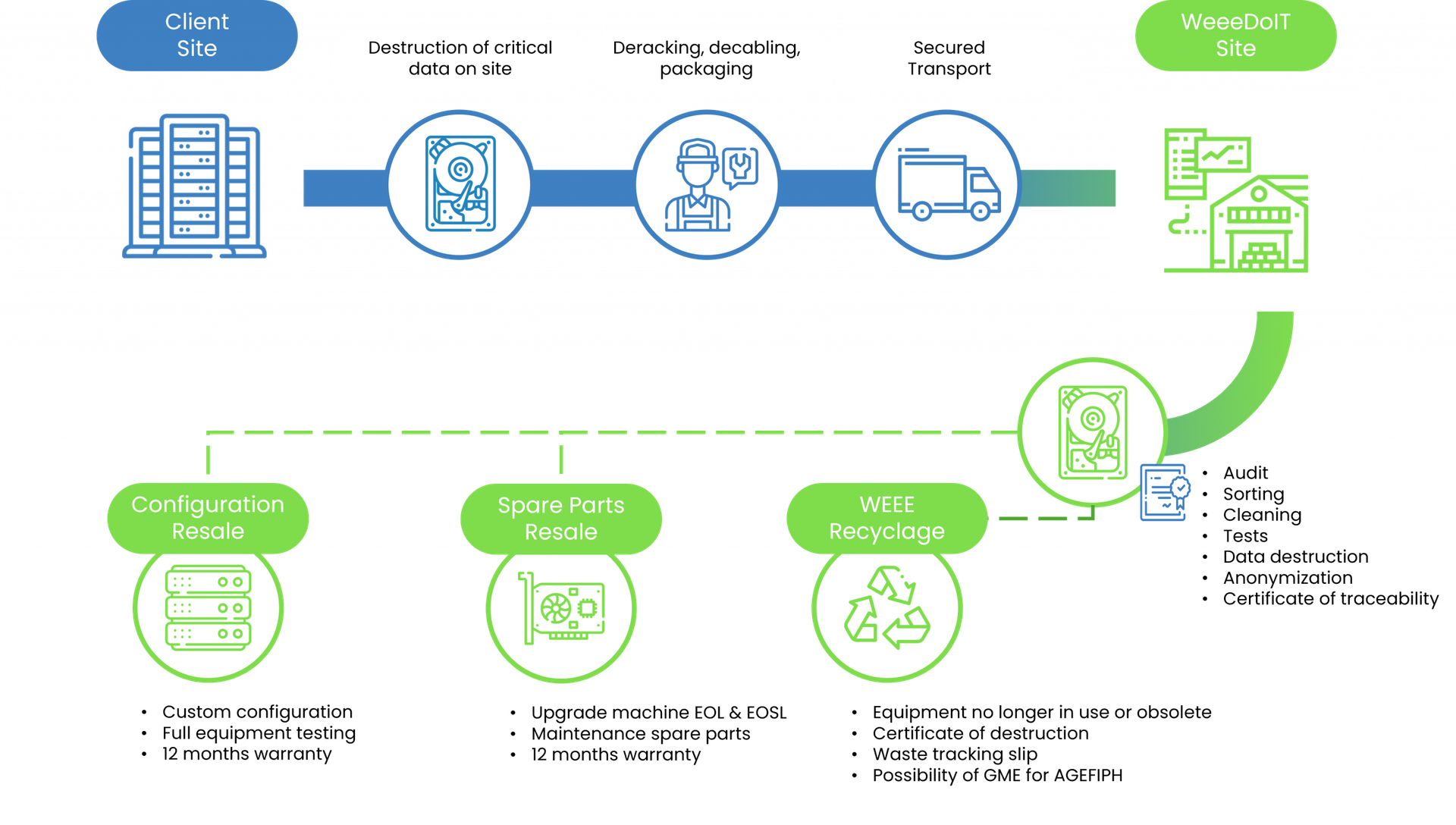
What happens at WeeeDoIT after the buyback?
What sets WeeeDoIT apart

Unique multi-brand expertise

European B2B buyer network

Buyback offer based on real value

Transparency, traceability, compliance
FAQ
Questions on IT Buyback & Refurbishment
What types of IT equipment can be remarked?
Most professional equipment retains value, even several years after it was first deployed. The most valuable items are those from the server and datacenter world: servers and compute nodes, storage arrays, enterprise switches and routers, power supplies, controllers, RAID cards, enterprise SSDs and high-capacity HDDs, blade chassis, and SAN modules. Professional workstations, RAM bars, GPUs, and certain 10/25/40/100 GbE network cards can also retain resale value.
How do you determine whether obsolete equipment should be resold, reused, or recycled?
We assess three dimensions: technical condition (boot, temperature, SMART errors, firmware consistency); market interest (sought-after generation, missing parts, scarcity, current compatibility); and ITAD feasibility (data erasure, refurbishment potential, security standards). If the equipment works → resale or reuse. If it partially works → component extraction (PSU, RAM, CPU, controllers…). If it’s too old or unstable → raw material recycling. In short: it’s not « waste » as long as it can function, be disassembled, or be processed for raw materials.
Which equipment is most in demand on the refurbished market today?
Professional ranges and rare parts are most sought after — particularly items that have gone out of manufacturer production: SAS drives, older-generation RAID cards, SFP+ modules, proprietary power supplies. In short: scarcity, reliability, and compatibility drive demand.
What criteria most influence the value of a piece of equipment?
The main criteria are: generation (a Gen10+ server is worth more than a Gen7); capabilities (CPU, RAM, drives, connectivity); physical condition (scratches, corrosion, dust, internal shock damage); usage hours (SMART data, SSD write cycles, logs); maintenance history (service records, replaced parts, operating environment); scarcity (parts no longer manufactured but still in high demand); and current market conditions (some generations regain value depending on needs). In short: value depends as much on actual condition as on market demand.
What is the impact of real or planned obsolescence on value?
Real obsolescence gradually reduces value: declining performance, outdated technology standards, firmware limitations, and increasing error and instability rates. Planned obsolescence can cause an artificial drop in value: end of manufacturer support, parts made incompatible, firmware lockdowns, and forced upgrade cycles. But as long as equipment still functions, it can be valorised — through reuse, component extraction, or material recycling. In short: obsolescence reduces value… but almost never eliminates it entirely.
How does a full collection process work?
A standard process includes: (1) on-site audit — equipment identification, cabling mapping, photos before disassembly; (2) secure disassembly — ESD gloves, power shutdown, clean extraction from racks and servers; (3) immediate sorting — resaleable equipment vs. potentially recyclable equipment; (4) data security — storage media removed and placed in sealed containers; (5) appropriate packaging — anti-shock foam, rigid cases, reinforced pallets; (6) secure transport — datacenter-adapted vehicles, shock-free routing, temperature-controlled; (7) workshop processing — testing, erasure, refurbishment, recycling. In short: a complete chain designed to prevent value loss, data risks, and physical damage.
What happens to functional equipment with no market value?
Three options are available, and the client chooses based on their CSR and IT policies. In short: equipment with no market value can still be useful — or recycled responsibly.
How is the buyback price calculated, and what processing costs may apply?
The buyback value depends on two axes: (1) the residual resale value of the equipment — model, condition, generation, scarcity, reusable components; and (2) the necessary processing costs — data erasure, disassembly and handling, certified recycling, secure transport, parts extraction. Equipment can have a positive value (buyback payment), a neutral value (zero-cost collection), or a negative value (WEEE recycling cost). In short: buyback value = equipment value minus processing costs.
What documents do you provide after collection and remarketing?
Depending on the options chosen: official WEEE transfer forms, data destruction or erasure certificate, detailed inventory of collected equipment, material recycling certificate, avoided CO₂ attestation / CSR report, and traceability by serial number and by flow. In short: complete documentation, useful for audits, CSR reporting, and compliance.
Can a multi-site or multi-country collection be organised?
Absolutely. Collections can be spread across multiple sites — or even multiple countries. Logistics are adapted to your organisation: we coordinate interventions through a single point of contact, then mobilise our certified partners across Europe and internationally to ensure the same quality standard everywhere. Each site is planned individually, taking into account access constraints, secure transport, packaging requirements, equipment types, and internal scheduling. The goal is simple: every machine, whether in another country or another datacenter, is collected, secured, and valorised under the exact same conditions as if the entire fleet were in one place. In short: central coordination, multi-site execution, consistent quality everywhere.